

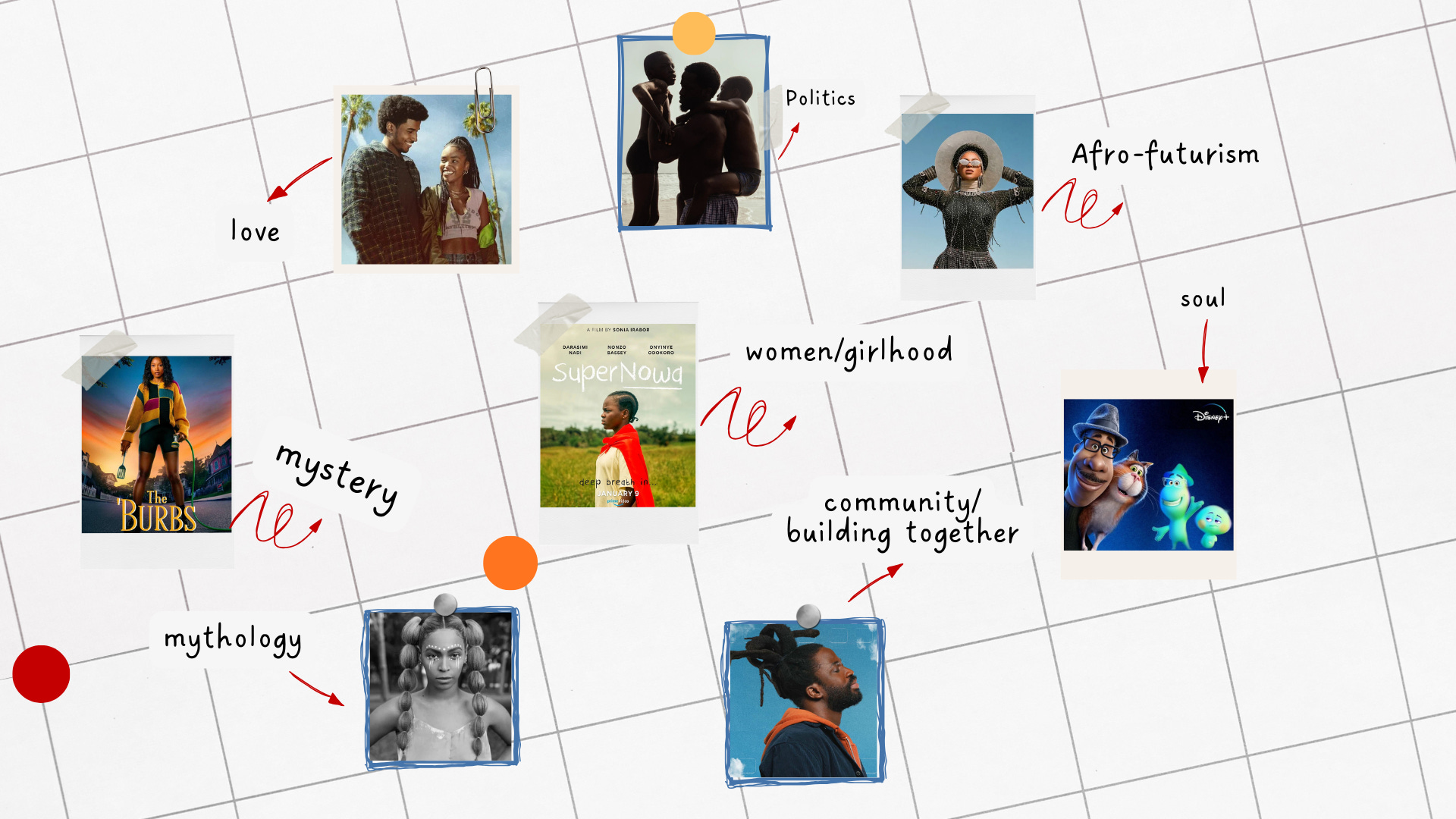
As we ushered in the Lunar New Year (the year of the Fire Horse) I made the decision not to make a vision board; something that previously had become an annual tradition.
The vision is already clear.
I know what kind of woman I am becoming. I know the texture of her life. I know the rooms she occupies. The conversations she entertains. The standards she refuses to lower.
I did NOT need a collage to remind me; what I need is a world that either validates that vision or sharpens it.
So instead of a vision board, I built a media board.
I want to be clear about this, a media board is not a watchlist.
It is a curated, thematic selection of films and television I intend to consume across the year. It is deliberate. It is modular. It evolves as new projects are announced. What initially started as a question on my tiktok about how to consume media with intention, morphed into a notebook list of films and television projects I felt inspired by or curious about, arranged into themes that are important to me, structured in a spreadsheet and translated into a visual board.
In doing this, I created my cultural syllabus. Because media is not neutral; every film teaches you something about the world around you. Films teach you about ambition, love, womanhood, the dynamics of power and so on. What you watch can teach you about what is rewarded and what is punished, whose voice is lifted and whose is silenced.
Media also opens your eyes to new worlds, allowing you to travel far beyond what your material circumstances can allow and sometimes, sometimes giving you a better contextualisation of the interior lives of others than you would have by sheer in-person witnessing. As a twelve year old girl watching Ousmane Sembene’s Faat Kiné, I was able to understand sexism and interfaith romance in contemporary Senegalese life. Through the relatability of Tunde Kelani’s Saworoide, I witnessed the use of allegory as a plot device and a tool of dissent, gaining a better understanding of how the vestiges of Nigeria’s colonial terror have been filtered through corruption and authoritarianism. And watching the 1982 film E.T., taught my young self about otherness, American surveillance state and government overreach (even though at that time, I was unable to fully conceptualise what I was watching).
And so it would seem that if I am serious about HER PERSONAL CURRICULUM - about designing my intellectual and emotional life with intention - my engagement with media cannot be accidental.
For years, my consumption was reactive. I watched trending films, absorbed entire seasons of shows without asking what they were feeding me, subjected my screen time to whatever clips were auto-played by the algorithms on social media platforms, and I am still shown these videos though to a lesser extent.
The Fire Horse, in the zodiac, is said to be intense, independent, unruly.
I do not know how much I believe in astrological determinism, but I understand symbolism. And this year, I wanted a symbol of refusal. Refusal to drift. Refusal to let the loudest story win.
So this time, I began with themes instead of titles.
I asked myself: who am I becoming, and what stories support that becoming?
Power and sovereignty. Feminist rage. Female anti-heroes. Political thrillers. African futurism. Community. Girlhood and memory.
Then I listed everything: upcoming releases, old films I had postponed, television shows I had “been meaning to watch”, announced projects that sparked something in me.
During this time (and in a familiar fashion to the framework of my multimedia feminist curriculum), I considered the possibility of accompanying media that would further contextualise my selection. After all, a similar approach was used to select accompanying resources in my multimedia feminist/womanist curriculum where books, films and research articles were selected not in isolation but in conversation with one another.
I began to wonder: what would it mean for my entertainment to also exist in conversation?
What would it mean for a political thriller to sit beside a long-form essay on state violence? For a film about motherhood to be accompanied by a memoir that sheds lights on reproductive labour? For a series about wealth and power to be watched alongside economic history or cultural critique?
So I aggregated. While aggregating titles, I also began to eliminate. I began to refine my selection through themes asking myself: “who am I becoming and what stories support that becoming?” What survived became structured in a Google Sheets document sorted by themes, film/series titles, recommended media pairing, film or book suggestions from HER PERSONAL CURRICULUM community members and a vote button (“Recommend 👍🏾”, “ehhh....depends 🤷🏾♀️”, “Nah 😒”).

That spreadsheet became “textual architecture” which I then translated into a visual guidebook on Canva. It showed me the atmosphere I was inviting into my year and that is what this is about.
The media we consume builds the emotional climate of our lives. If my media input is filled with anti-blackness, sexism, dysfunction, and spectacle — there is no surprise if that becomes the background frequency of my thinking.
But if I’m building a life rooted in feminist world-building, media literacy, creative sovereignty, and critical thinking….. then my inputs must reflect that.
In a few steps, I will show you how to curate your media inputs the same way you curate your ambitions, relationships and life.


Step 1: Start With Themes, Not Titles
Before listing any film or TV show, ask: What world am I building internally and externally? Who am I becoming this year?
For examples, your themes might look like:
Girlhood & memory
Political thrillers
African futurism
Female anti-heroes
Feminist rage
Cultural reclamation
Sport
Themes first. Titles second. Themes prevent you from drifting. You can also later introduce new themes if certain commonalities appear here which have not been represented in the themes earlier stated.
Step 2: Brain Dump Everything
Now list:
Upcoming 2026 releases
Films you’ve postponed
Shows you’ve “been meaning to watch”
Announced projects that interest you
Step 3: Sort, Rank, Eliminate
This is where it becomes a curriculum. In my Media Board spreadsheet, I created columns for:
Viewing Month
Theme
Title
Format (Film / Series / Documentary)
Post-viewing score
Recommended/Similar/Alternative media
Member Suggestions
Step 4: Make It Modular
A media board is not static. I add newly announced/released films that I was unaware of when I initially created the board. I also reserve the right to remove films or tv shows that I am no longer interested in viewing (from what I’ve heard about season 2, I think Hijack might be on the chopping block). When new films or shows are announced, I evaluate them against my themes.
If they fit? They’re added. If not? They’re admired from afar.
This keeps the board alive but not chaotic.
It’s also important to remember that this is a guide not set in stone, we all have busy lives with responsibilities and people calling for our attention. You do not have to watch every planned media but this board invites you to a more intentional engagement with your time and attention.
Step 5: Create a Visual Board (optional)
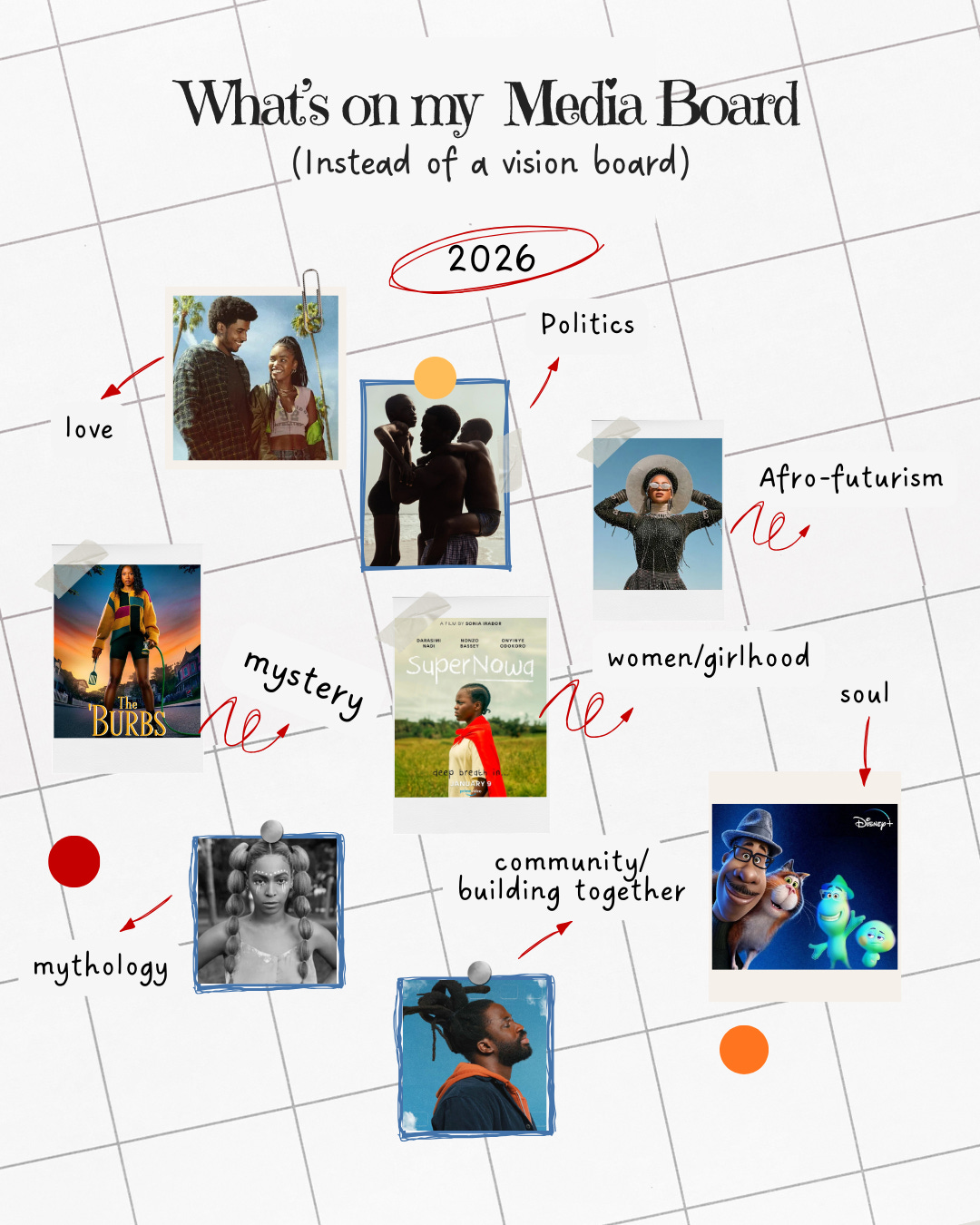
After finalising the spreadsheet, I created a visual board using Canva both for social sharing and to help my neurodiverse brain visual conceptualise the themes I was running with.
Seeing the covers together revealed tone, imbalance, repetition. It showed me the atmosphere I was inviting into my year. If this final aspect would be useful to you, feel free to implement; if not, the spreadsheet is completely fine.
Media Is a World-Building Tool, Build Yours
The stories we let into our days and evenings eventually settle into our interior life. They shape our metaphors, fears, ambitions and our sense of what is possible.
If HER PERSONAL CURRICULUM is about engaging with media and culture intellectually, emotionally and politically then media cannot be treated as filler between “real” pursuits.
Media has always been a teacher, and in 2026, I am choosing the syllabus.